When the Doors Are Shut: A Kitchen's Own December Supper
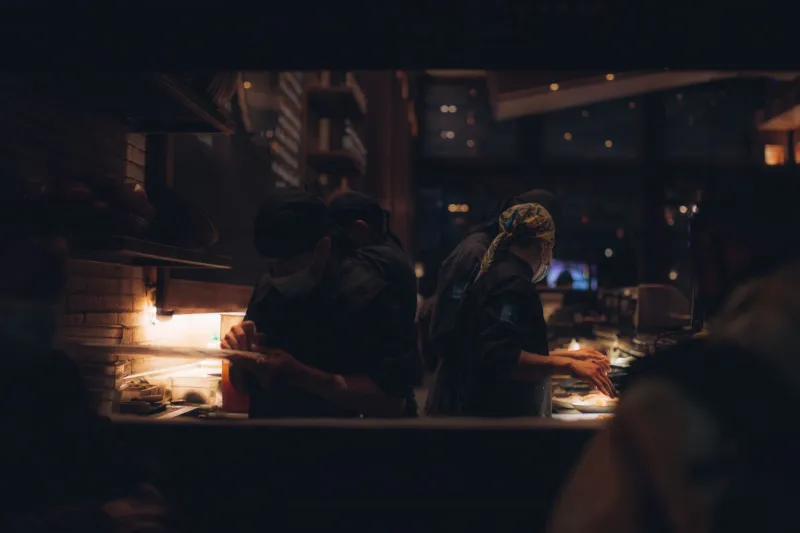
The last guest leaves at 11.04pm. The door is locked, the blinds are down, and the kitchen — which half an hour ago was a wall of noise — goes quiet enough to hear the extractor fan winding down. Then someone says the words that matter more than any menu briefing: 'What are we eating?'
The Second Service
Staff tea at The Bay Tree is not a scheduled event. It happens after service, when the last plate has gone out and the pass has been wiped. It is the meal the team cooks for itself, and by December it has its own rhythm. There is no printed menu. There is a shelf of odds and ends, a few portions of whatever sold less well than expected, and a standing rule that nobody eats standing up.
You might think a kitchen full of professional cooks would produce something elaborate. In practice, the opposite is true. The food is plain, fast and deeply satisfying: a pie made from the trimmings of the day's roasts, a bowl of buttered greens, a jug of gravy that has been quietly improving since lunch. If there is bread, it is toasted. If there is cheese, it is out on a board before anyone has taken their coat off.
What Goes In
The best staff teas are built from what the menu cannot use. A handful of roasted carrots. The last of the celeriac. A few rashers of bacon that did not make it into the sprouts. In December, the shelf is full of these fragments — the busy season produces plenty of them — and the staff meal is where they get a second life.
This is not a cost-saving exercise dressed up as culture. It is a habit that makes sense in a neighbourhood kitchen. We cook seasonally, which means we buy what is good and use what we buy. The staff tea is the final link in that chain. A pie made from Sunday's beef and Monday's potatoes is not a compromise; it is the most honest thing on the premises.
The Last Potato Debate
Every kitchen has its rituals, and ours has the last roast potato. By the time the staff sit down, the tray has been picked over. There is always one potato left, and there is always a discussion about who should have it. The discussion is never serious, but it is never skipped. Someone will claim they worked hardest. Someone will point out that the person on the fish section has not sat down yet. Someone will offer to split it and then eat most of it.
It sounds trivial. It is not. The last potato is a small, repeatable lesson in sharing the good things. It is also a reminder that the people who cook for a living spend most of their waking hours thinking about what other people are eating. The staff tea is the one moment in the day when the question is reversed.
A Barometer of the Kitchen
Ask anyone who has worked in hospitality and they will tell you that staff meals are a reliable indicator of how a kitchen is run. A team that eats together, properly, is usually a team that talks to each other. A team that eats standing up, separately, in silence, is usually a team counting the minutes.
At The Bay Tree, staff tea is not a perk we advertise. It is a habit we protect. In December, when the days are long and the list of bookings is longer, it is the half hour that keeps the rest of the shift human. It is also when the best ideas happen. A conversation about the following week's menu, a complaint about a supplier, a joke that gets repeated for the rest of the month — none of it would survive without the table.
Nothing Fussy, Nothing Wasted
The food itself is deliberately unfussy. There is no plating. There are no tweezers. There is a stack of plates, a pot of something hot, and a bowl of something sharp. If it is December, there will be a pie. If it is late December, there will be a pie made from the pie that did not sell. Nobody minds. The pastry is still good, the filling has had time to think about itself, and the gravy is better than it has any right to be.
This is also where the kitchen's approach to waste becomes practical rather than theoretical. We are not claiming to have solved food waste. We are saying that a staff meal is one of the simplest ways to make sure good ingredients do not go in the bin. A few sprouts, a spoonful of bread sauce, the end of a ham — these are not leftovers. They are the beginning of something else.
The Quiet Ritual
By midnight, the plates are stacked, the lights are off, and the team is heading out into the cold. The staff tea is not on the menu and it never will be. But it is part of the hospitality we offer, in the sense that a kitchen that looks after its own people is a kitchen that looks after its guests. You cannot separate the two.
So the next time you book a late table in December, know that there is another service after yours. It is quieter, shorter, and a little more argumentative. It is the meal that makes the rest of the day possible. And yes, there is always one last potato.